Optimal Pricing Strategies Through the Price Waterfall
- February 6, 2026
- Posted by: SFDCGYM
- Category: Salesforce CPQ ,
Navigating the Price Waterfall in Salesforce CPQ for Optimal Pricing Strategies
In the intricate world of sales and pricing, understanding the nuances of price calculation can significantly impact your bottom line. For those navigating Salesforce CPQ, mastering the price waterfall is a critical step towards optimizing pricing strategies and ensuring accurate quotes. This blog post will guide you through the foundational aspects of Salesforce CPQ pricing, exploring each pricing type within the price waterfall, and providing practical examples to illustrate their applications.
Understanding Salesforce CPQ Pricing
Salesforce CPQ (Configure, Price, Quote) is a robust tool designed to streamline the pricing and quoting process within businesses. It automates the configuration of product bundles, applies pricing rules, and generates accurate quotes, enhancing the efficiency of sales processes. Understanding the price waterfall within Salesforce CPQ is crucial for administrators, sales managers, and developers who aim to harness its full potential.
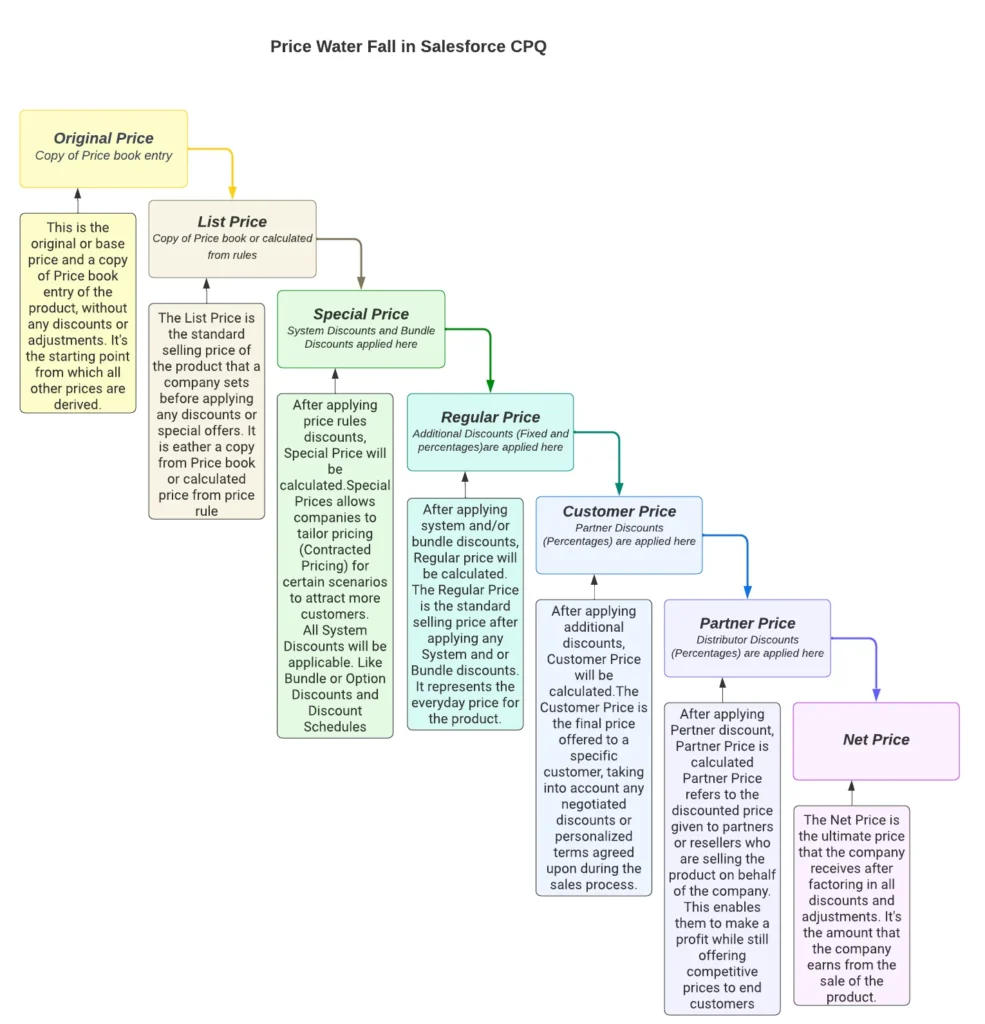
The price waterfall is an essential aspect of Salesforce CPQ, representing the sequential calculation process that determines the final price a customer will pay. It starts with the list price and incorporates various discounts, surcharges, and conditions to arrive at a final customer price.
The Role of Original Price
The original price is the base price of a product before any modifications or discounts are applied. It serves as the starting point for all subsequent pricing calculations. Understanding the original price is essential for CPQ administrators and sales managers to establish a benchmark against which all adjustments are made.
Within the context of Salesforce CPQ, the original price plays a pivotal role in setting expectations for both sales teams and customers. It is the reference point from which discounts are calculated, ensuring consistency and transparency in pricing strategies.
Decoding the List Price
The list price represents the standard market price for a product, typically the highest possible price without any discounts. It is often used as a reference point when communicating with customers and establishing perceived value. Salesforce CPQ allows businesses to define and manage list prices systematically.
For sales managers and developers, understanding how list prices are configured and utilized in Salesforce CPQ is crucial for maintaining competitive pricing strategies. By effectively managing list prices, businesses can position their products strategically in the market.
Special Price Considerations
-
Special pricing involves the application of promotional discounts or time-limited offers to attract customers. In Salesforce CPQ, special pricing is a flexible tool that allows businesses to respond quickly to market changes or specific customer demands.
CPQ administrators can configure special pricing rules to automatically apply discounts based on predefined conditions, such as seasonal promotions or bulk purchases. This capability enhances the adaptability of Salesforce CPQ, enabling businesses to create compelling offers dynamically.
Exploring Regular Price Dynamics
The regular price is the adjusted price after considering standard discounts that apply consistently across the board. It is particularly relevant in scenarios where businesses have established long-term pricing agreements with their customers.
Understanding the regular price within the price waterfall is essential for ensuring that standard discounts are correctly applied and communicated to customers. Salesforce CPQ simplifies this process by automating the application of these consistent pricing rules.
Navigating Customer Price Adjustments
The customer price reflects the price offered to a specific customer, taking into account negotiated terms and unique conditions. This customization is a powerful feature of Salesforce CPQ, allowing businesses to maintain strong relationships with key accounts.
Sales managers and CPQ administrators must be adept at configuring customer-specific pricing agreements within Salesforce CPQ. By doing so, they can ensure that each customer’s unique needs and expectations are met, further strengthening business relationships.
Partner Price and Collaborative Strategies
Partner pricing involves offering adjusted prices to business partners or resellers based on collaborative agreements. In Salesforce CPQ, partner pricing is a strategic tool that facilitates cooperation between businesses and their partners.
For CPQ administrators, understanding how to configure partner pricing agreements is vital for leveraging collaborative relationships. By offering competitive partner prices, businesses can expand their reach and enhance their market presence.
Unveiling the Net Price
The net price represents the final price a customer pays after all discounts, surcharges, and conditions have been applied. It is the culmination of the price waterfall process within Salesforce CPQ.
Ensuring the accuracy of the net price is critical for sales managers and developers. By leveraging Salesforce CPQ’s capabilities, businesses can automate complex pricing scenarios, reducing errors and enhancing customer satisfaction.
Interrelationships Between Pricing Types
The net price represents the final price a customer pays after all discounts, surcharges, and conditions have been applied. It is the culmination of the price waterfall process within Salesforce CPQ.
Ensuring the accuracy of the net price is critical for sales managers and developers. By leveraging Salesforce CPQ’s capabilities, businesses can automate complex pricing scenarios, reducing errors and enhancing customer satisfaction.
Practical Example of Pricing Application
To illustrate the application of the price waterfall concept, consider a hypothetical scenario involving a software subscription product. The original price is set at $1000, with a list price of $1200. A 10% special discount is applied during a promotional period, resulting in a special price of $1080.
A regular customer who has negotiated a 5% discount receives a regular price of $1026. Meanwhile, a key account customer benefits from a 15% customer-specific discount, resulting in a customer price of $918. A trusted partner receives a 20% partner price, leading to a final net price of $800.
This example demonstrates how different pricing types interact within the price waterfall, showcasing the flexibility and adaptability of Salesforce CPQ in handling complex pricing scenarios.

Enhancing Sales Efficiency with Salesforce CPQ
Mastering the price waterfall within Salesforce CPQ empowers businesses to improve sales efficiency and customer satisfaction. By automating pricing processes and ensuring accurate quotes, businesses can streamline operations and enhance decision-making.
Sales managers and CPQ administrators play a pivotal role in configuring and optimizing pricing rules within Salesforce CPQ. By leveraging the platform’s capabilities, businesses can achieve competitive pricing strategies that drive growth and success.
Conclusion
The price waterfall concept in Salesforce CPQ is a powerful tool for businesses aiming to optimize their pricing strategies and improve sales efficiency. By understanding the sequential flow of pricing calculations and the interrelationship between different pricing types, CPQ administrators, sales managers, and developers can enhance their pricing processes and deliver accurate quotes to customers.
For businesses looking to maximize the value of Salesforce CPQ, mastering the price waterfall is essential. By leveraging the platform’s capabilities, businesses can achieve competitive pricing strategies that drive growth and success.
To further explore the possibilities of Salesforce CPQ and optimize your pricing strategies, consider reaching out to experts in the field. With the right guidance and support, you can unlock the full potential of Salesforce CPQ for your business.
Summary Of this Article
Salesforce CPQ (Configure, Price, Quote) is a dynamic tool designed to enhance the efficiency of sales processes by automating the configuration of product bundles, applying pricing rules, and generating precise quotes. A core component of this tool is the price waterfall, a sequential calculation process that determines the final price a customer will pay. This begins with the list price and incorporates various elements such as discounts and surcharges, culminating in an accurate customer price. Understanding the price waterfall is pivotal for businesses aiming to optimize their pricing strategies.
Within this framework, several pricing types play a crucial role. The original price serves as the base figure for all subsequent calculations, providing a benchmark for pricing strategies. The list price is typically the highest possible market price without any discounts, used as a reference to establish perceived value. Special pricing, on the other hand, introduces promotional discounts or offers to attract customers swiftly in response to market demands. Regular pricing involves consistent discounts applicable across the board, often seen in long-term agreements.
The customer price is tailored to specific clients based on unique terms, fostering robust customer relationships. Partner pricing is adjusted for business partners, enhancing collaborations. Finally, the net price represents the final amount after all calculations, ensuring transparency and satisfaction.