What is Agentforce Revenue Management?
- April 26, 2026
- Posted by: SFDCGYM
- Category: Revenue Cloud ,
For years, growth-oriented companies have lived with a silent productivity problem. This problem is the fragmented revenue engine. In this outdated model, the teams responsible for quoting, contracting, and billing operate in disconnected groups. They use different systems that rarely share the same data. Because of this separation, companies experience chronic revenue leakage. Manual hand-offs and spreadsheet errors cause incorrect invoices. They stall renewals and hide the true financial health of the business.
The era of the passive ledger is over. What does this mean for modern businesses? It means a revenue engine that only records historical data is a liability. Recent industry data reveals that 85% of service decision-makers now expect their teams to drive growth through upselling and retention. To compete in this environment, organizations must shift their approach. They need to move from recording revenue as a series of static entries to orchestrating it through a unified, intelligent platform.
We are entering the age of Agentforce Revenue Management. This represents a fundamental shift in the Salesforce architecture where technical complexity is managed by digital labor. This system is designed for a new reality. Humans make strategic, high-level decisions, while autonomous AI agents handle the heavy lifting and enforcement of the quote-to-cash cycle.
If you are a sales operations manager or a Salesforce Admin/Developer, this guide will equip you with a clear understanding of Agentforce Revenue Management. You will learn how the platform evolves past traditional CPQ, how digital labor functions in daily tasks, and how to prevent common billing failures.
Beyond CPQ: The Evolution to Revenue Lifecycle Management
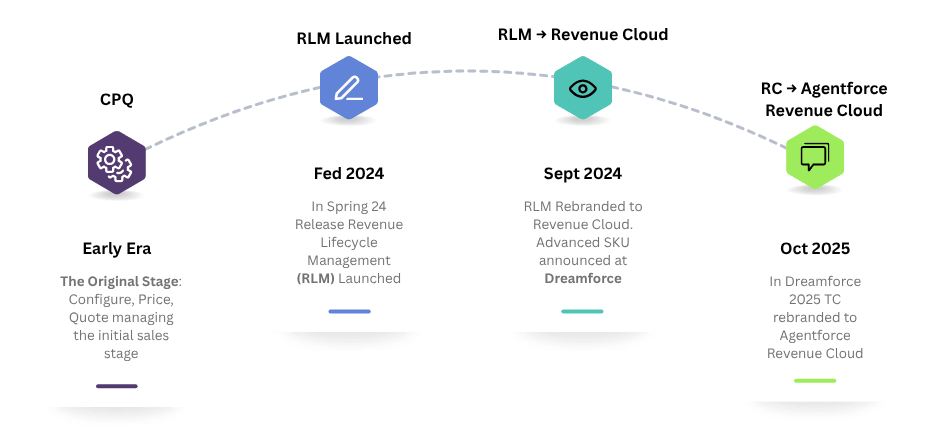
Many leaders are familiar with traditional Salesforce CPQ. CPQ stands for “configure, price, and quote.” In simple words, Salesforce CPQ helps the sales team of an organization price their products and send quotes to clients in a streamlined manner. However, the platform recently underwent a massive evolution. It was rebranded as Revenue Lifecycle Management (RLM) in the Spring of 2024. Then, it was reintroduced as the foundation for Agentforce Revenue Management at Dreamforce 2025.
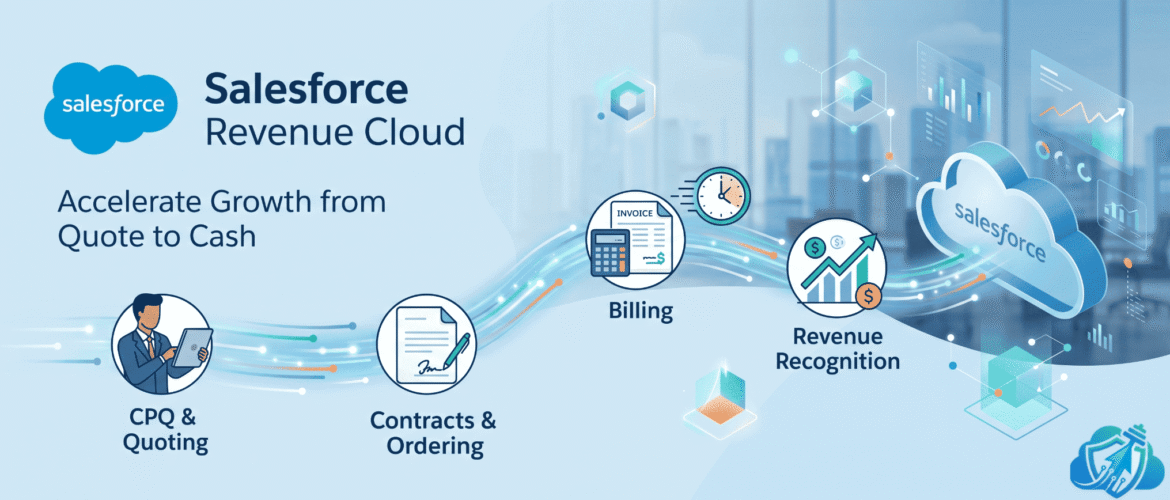
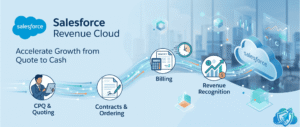
This evolution expands the horizon from a front-end sales tool to a comprehensive financial orchestrator. The expanded scope moves the needle across the entire journey of a dollar.
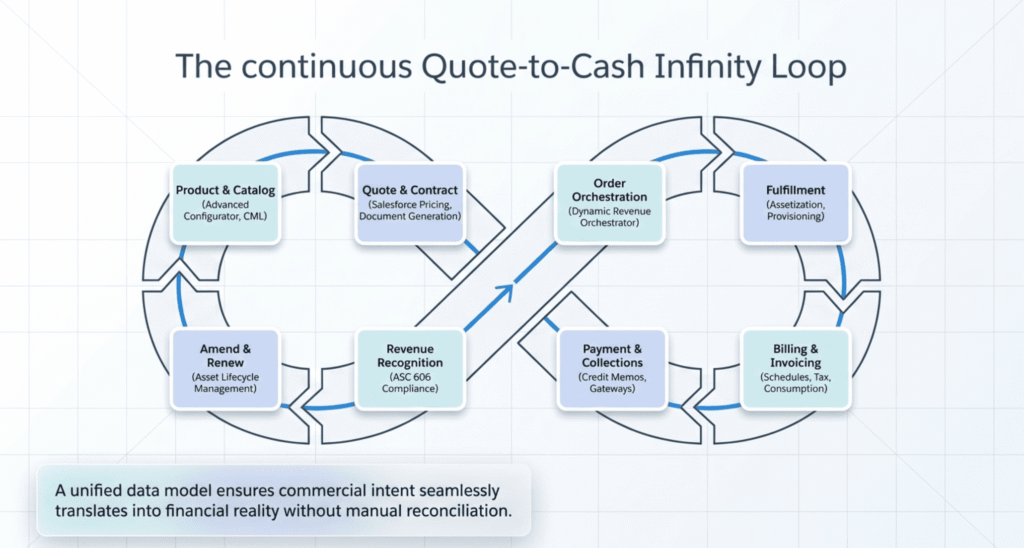
Here is how the platform manages each step of the revenue journey:
- Configure: Complex product bundling and attribute-based catalogs operate at scale. Sales teams can group hardware, software, and services together easily.
- Price: Dynamic logic applies automatically to the quote. This includes volume, tiered, and loyalty-based discounts.
- Quote: Guided selling and automated document generation speed up the sales process. Representatives can generate accurate PDF proposals in seconds.
- Cash: Integrated billing, invoicing, and payment processing keep cash flow consistent. The system tracks when payments are due and when they are collected.
- Recognition: The system automates compliance with revenue recognition standards like ASC 606 (the US standard for how companies recognize revenue from contracts with customers) and IFRS 15 (its international equivalent), ensuring revenue is recognized at the legally correct time.
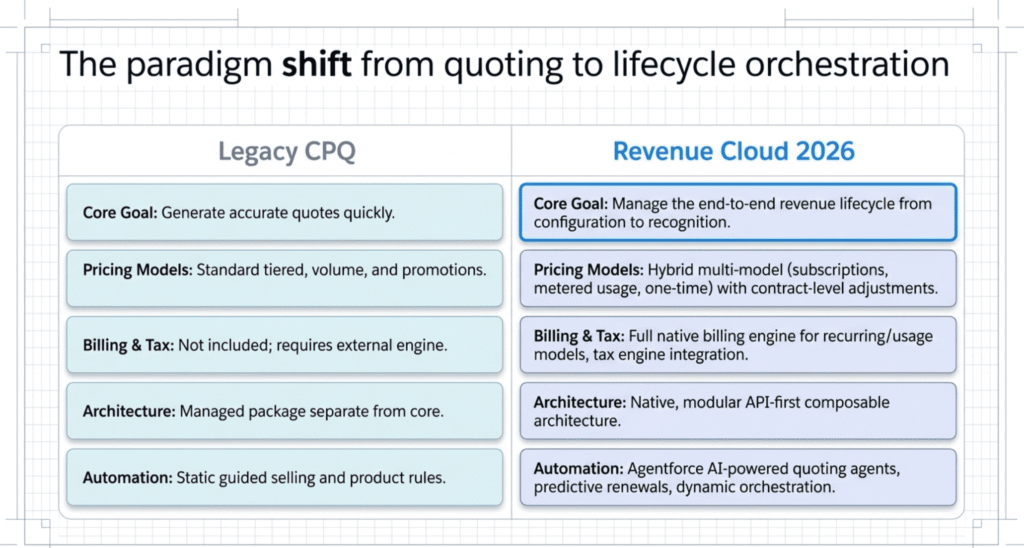
How Revenue Cloud (RLM) is better than CPQ?
The Quoting Agent: Turning AI into Digital Labor
The transition to Agentforce marks the end of AI as a passive analytics layer. AI is no longer just providing a dashboard of what happened in the past. It has become an active participant capable of reasoning and orchestration. In this framework, the Quoting Agent acts as digital labor. It performs tasks that previously bogged down sales operations for days.
Once you have set up your product catalog, how do sales representatives use it effectively? The Quoting Agent allows them to generate complex quotes and amendments using simple, natural-language prompts.
Crucially, the agent does not just fill in text fields. It enforces business rules and pricing guidelines in real time. This ensures that what is sold is exactly what can be invoiced.
Increased Efficiency: By using the Quoting Agent, repetitive quoting tasks become automated, reducing manual input and human error.
This shift changes the salesperson’s role. They move from acting as a data entry clerk to serving as a strategic decision-maker focused on the customer relationship. For instance, instead of spending two hours manually calculating a prorated contract upgrade, the sales representative simply types a request into the system. The agent calculates the exact proration, applies the correct discounts, and generates the amended quote for approval.

Onetime, Subscription and Consumption based Products
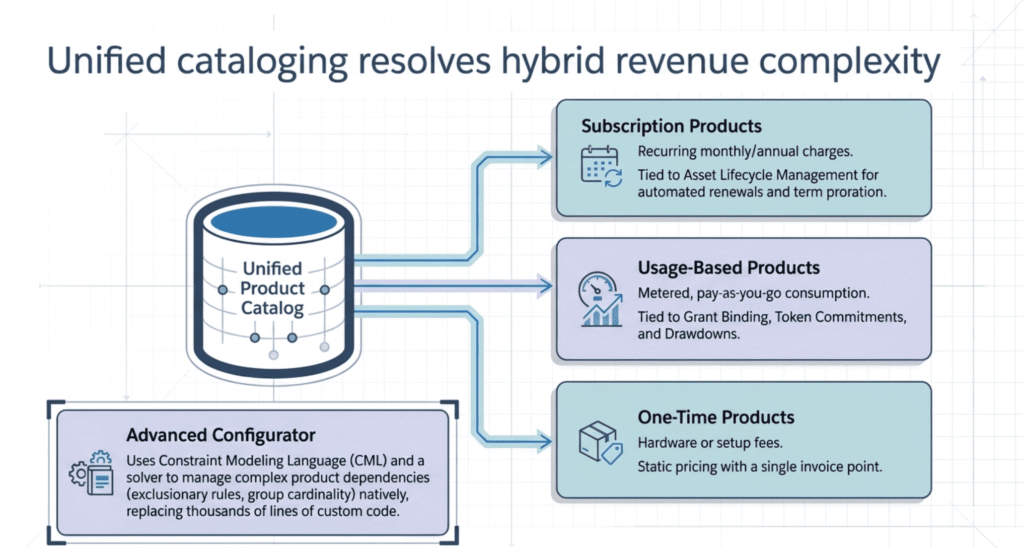
Modern B2B software organizations rarely sell in a single dimension. The market demands hybrid models that combine various pricing patterns into a single customer contract. Historically, this requirement created manual reconciliation nightmares for finance teams.
Agentforce Revenue Management handles four core models natively to solve this problem:
- Subscription: Recurring charges on a defined cadence. These are typically billed on a monthly, quarterly, or annual basis, such as a yearly software license.
- Consumption / Usage-Based: Usage-based billing where the amount is driven by metered data. Customers are billed based on exactly how much of a service they consume, like gigabytes of cloud storage.
- One-Time: Product that can be sold one time. For example: Laptop, TV, Table, etc.
- Hybrid: A combination of any of the above within a single customer contract. A customer might buy a physical server (static), a monthly maintenance plan (subscription), and pay for specific data processing overages (consumption).
To manage the volatility of usage-based models, the platform introduces Digital Wallet functionality within the Usage Management module. In simple words, a digital wallet allows customers to prepay for consumption and draw down those balances against rated usage.
Order Orchestration: Bridging the Gap with Order Decomposition
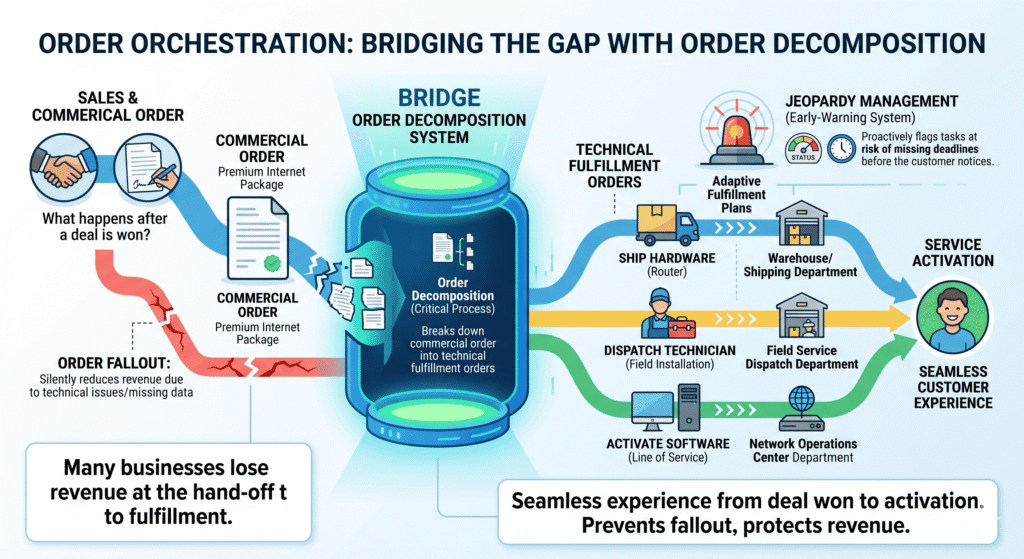
What happens after a customer places an order? The next step is Order Orchestration, which handles the process from sales to fulfillment. This is where many businesses lose revenue without realizing it.
Revenue often breaks during the hand-off between sales and fulfillment. Order Fallout is the term used when orders stall because of technical issues or missing data. This fallout silently reduces revenue. To prevent this, a modern system performs a critical process known as Order Decomposition.
Order Decomposition breaks down a commercial order (what the customer signed) into the technical fulfillment orders needed for delivery.
For example, imagine a telecommunications company sells a new internet package. The commercial order just says “Premium Internet Package.” To fulfill this, the company must complete several tasks. Order Decomposition splits the single commercial order into these distinct technical steps:
- Ship hardware: A router must be sent to the customer’s location.
- Dispatch technician: A field service agent needs to be scheduled for installation.
- Activate software: A specific line of service must be turned on in the system.
Each of these technical orders is then routed to the correct department. This process is managed using adaptive fulfillment plans. By using Jeopardy Management, operations leaders can proactively identify and fix tasks at risk of missing deadlines.
Jeopardy Management is essentially an early-warning system. It flags orders that are falling behind schedule before the customer even notices a delay. This ensures a seamless experience from the moment a deal is won through to final service activation.
The Billing Layer: Where Upstream Errors Surface
In revenue operations, billing breaks quietly. Unlike a failed sales call, a billing error might remain undiscovered for months. These errors compound as they move downstream into financial reporting. A sophisticated strategist knows that errors in the billing layer are almost always symptoms of misconfigured pricing or catalogs upstream.
For finance leaders, the single source of truth provided by a unified data model is the only cure for manual reconciliation. When the quoting data and billing data live in the same system, the numbers finally align.
However, it is vital to understand the SKU architecture before setting up your billing systems.
- Revenue Cloud Advanced SKU: This provides basic invoicing capabilities suitable for straightforward sales motions.
- Revenue Cloud Billing SKU: This is required for companies needing customizable billing structures, consumption models, or external tax engine integrations like Avalara or Vertex.
When managing the billing layer, there are three critical failure patterns to monitor:
- Selling Model Misconfiguration: This occurs when a recurring product is incorrectly set as a one-time charge. As a result, future billing cycles fail silently, and the company stops collecting recurring revenue.
- Legal Entity Errors: This involves mapping an order to the wrong subsidiary. When this happens, it creates massive tax jurisdiction problems and compliance exposure for the business.
- Amendment Proration Gaps: This happens when systems fail to account for how mid-term upgrades or downgrades affect partial-period charges. If a customer upgrades their software halfway through a month, they should only be charged for that half. Failing to calculate this accurately leads to disputed invoices and eroded trust.
By understanding these failure patterns, your finance team can configure rules within Agentforce Revenue Management to catch data errors before they ever reach an invoice.
The Future is Agentic
The shift to Agentforce Revenue Management is a fundamental reimagining of the relationship between human expertise and technological execution. This transition is not about replacement. It is about empowerment.
By allowing autonomous AI agents to handle the busy work of rule enforcement, order decomposition, and invoice explanation, your team is finally free to focus on actual growth. Your sales representatives can spend more time talking to customers. Your finance team can spend more time analyzing profitability instead of chasing down spreadsheet errors.
As you evaluate your current technology stack, ask yourself one final question. Is your current revenue engine merely recording your history, or is it actively orchestrating your growth? In the agentic era, your revenue engine should not just be a cost center. It should be your most competitive advantage.
Latest blogs
Calculated vs Streaming Insights in Data 360
Activation and Activation Targets in Data Cloud