
Agentforce vs Einstein: Which Salesforce AI Strategy Wins in 2026?


Key Differences between Salesforce Einstein Copilot and Agentforce
Most people who have worked or are working with Salesforce might have observed that the Salesforce AI tools are not always about flashy features. The focus is more about embedding AI intelligence with workflows to achieve quick and improved decision-making and accurate outcomes.
On one hand, where the Einstein Copilot assists sales reps in drafting email content, providing predictive insights and recommendations, the Agentforce functions autonomously to troubleshoot problems, provide automatic answers to customer queries, and intelligently suggest products to customers.
So, what’s the difference? They both belong to Salesforce’s AI ecosystem and perform similar tasks. Well, the difference lies in how they operate and in how much autonomy they are given. This blog breaks down Agentforce vs Einstein in practical terms- functional differences, industry-specific applications, benefits and limitations.
The Evolution from Einstein Copilot to Agentforce
Built on the Salesforce Einstein, the Einstein Copilot combines the power of Salesforce CRM with an AI assistant to allow users to interact with CRM data using natural language. It is designed as a conversational assistant to answer customer queries, produce content, or perform workflow automation within Salesforce applications.
But, unlike other AI assistants that have inadequate access to company data, the Einstein Copilot has access to full CRM data, giving it the ability to produce answers anchored to the internal data and information of the company. This ensures that the responses it produces are accurate, personalized, and relevant to the context.
Reasons for Transition to Agentforce
Although Einstein Copilot functions as an intelligent layer, it still needs a prompt to react or respond. For example, if salespeople want to write an email to the customer, then they need to ask the Copilot to create a draft, meaning it can’t take actions on its own and serves only when asked.
While this functionality might work with small sales, marketing, or CRM teams, as enterprises mature, expectations from AI also increase. Businesses need:
- AI to take complete end-to-end actions on its own, without the need to ask.
- Understand both structured as well as unstructured data to provide answers.
- Minimum handoffs between human agents and AI automation.
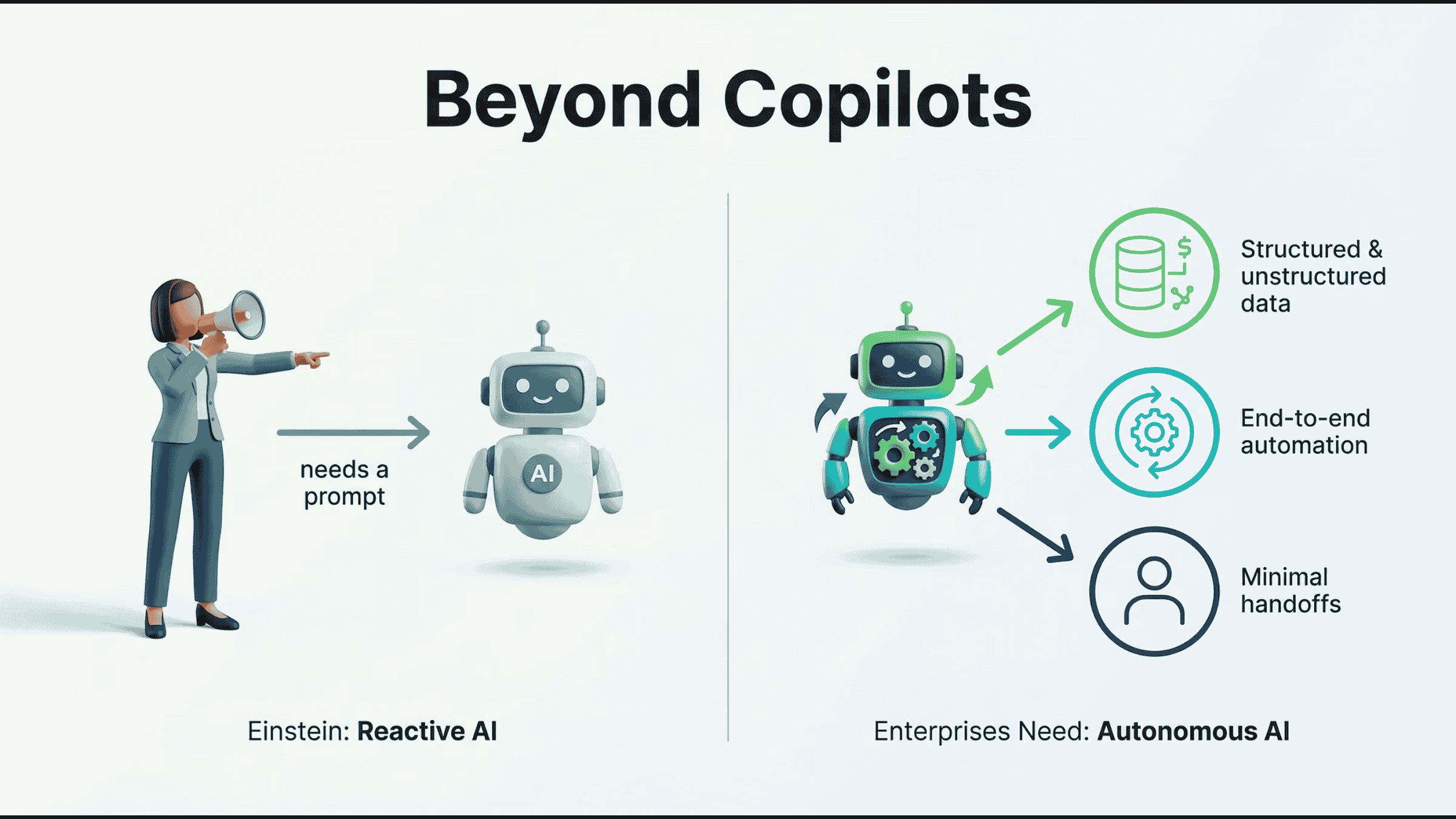
To fill these gaps, automate execution, enabling autonomous AI vs predictive AI Salesforce capabilities at scale, Agentforce emerged as the conversational coach rather than a simple advisor.
Understanding Agentforce
Marc Benioff, Chair, CEO & Co-Founder, Salesforce, stated: “Agentforce represents the third-wave of AI-advancing beyond Co-pilots to a new-era of highly accurate, low-hallucination intelligent agents that actively drive customer success.”
In simple words, Agentforce is the latest Salesforce framework that performs autonomously to execute workflows without any human intervention across the CRM systems. It uses the Atlas Reasoning Engine, Salesforce Data Cloud and Einstein trust layer, and deploys role-specific AI agents. These agents act independently, perform reasoning and make decisions across the entire customer journey.
Key Features of Agentforce
Let’s go through some of the important features of Agentforce:
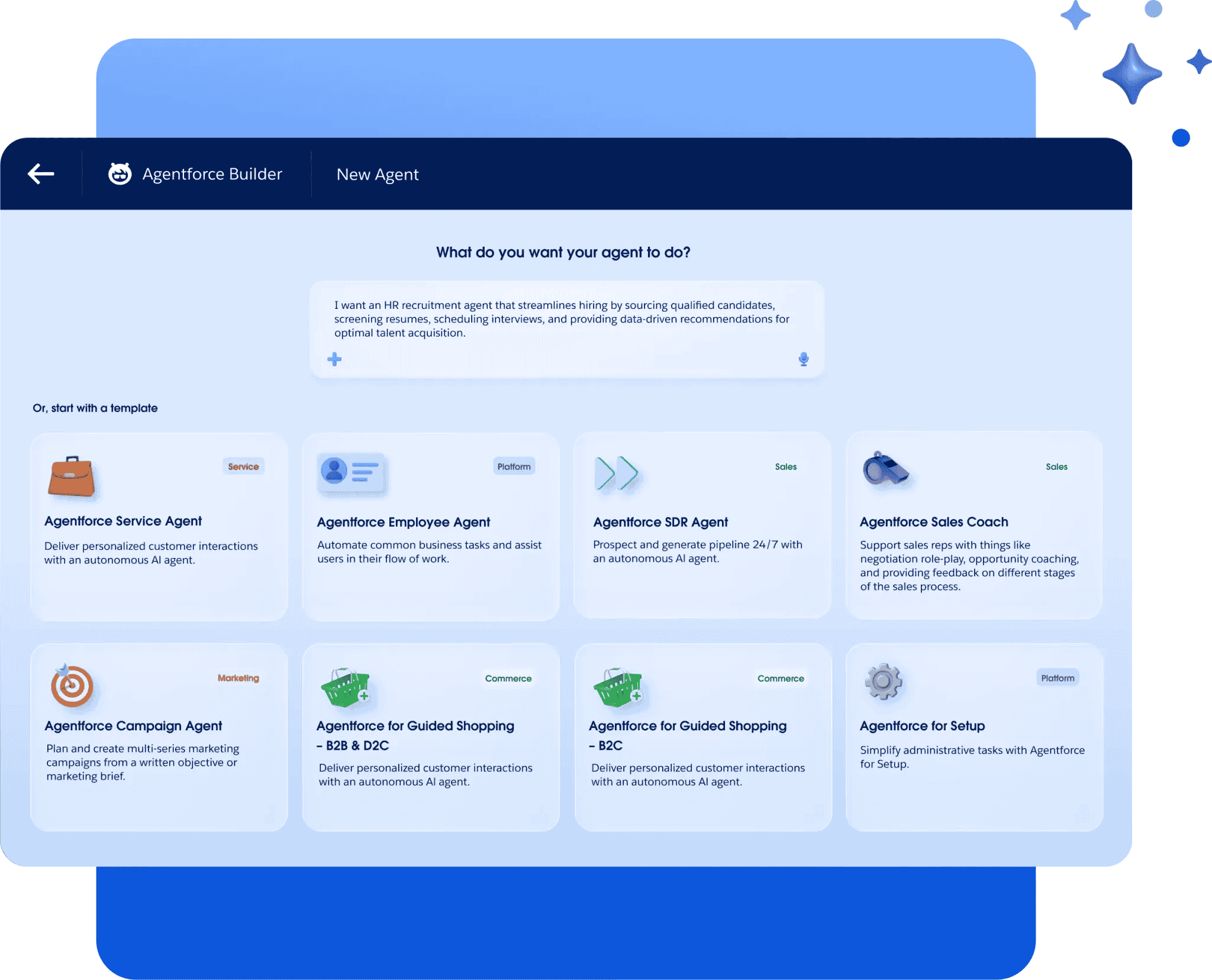
- Agentforce Builder: Using Agentforce Builder’s pre-built blocks, businesses can design powerful AI agents. These AI agents can be integrated with guardrails and defined instructions and can be connected across multiple channels, data, and Salesforce assets.
- Agentforce Automation: It can automate everyday tasks such as email follow-ups, managing and updating records, handling and scheduling calls, and ensuring no such daily administrative task slips out or go unattended.
- Lead Management: Agentforce has powerful capabilities to discover and capture leads from multiple sources. It identifies leads, scores them, and nurtures them using personalized interactions and communication.
- Agent Script: Bundling natural language with programmatic expressions, the Agent Script can be used by business teams to specify conditions, loops, and generate context-aware workflows.
- Powerful Reasoning and Predictive Analytics: It uses RAG capabilities, advanced reasoning, and predictive analytics to understand the query context and then deliver an accurate response.
Role-Specific AI Agents
Agentforce can be used to deploy agents using specific knowledge, guardrails, and actions, according to different industries such as sales, marketing, or customer service.
- AI agents, when deployed in customer support, can autonomously resolve customer queries and even perform escalations to human support agents if required.
- In sales, the AI agents can identify and qualify leads, update selected opportunities, and nurture those leads through automated personalized emails.
- AI agents can be used to provide an enhanced customer shopping experience by guiding shoppers through product discovery, personalized product recommendations, answering questions, and simplifying the payment process.
Real-world example: To prioritize sellers’ time using a unified sales approach, Siemens deployed Agentforce AI agents that could respond to 100% of the inbound leads and convey only quality leads to the sellers.
Data Privacy and Security within Agentforce
The Salesforce Agentforce is anchored with an Einstein trust layer Salesforce that provides early-stage protection for customer data.
- It ensures LLM interactions operate on a zero-retention basis.
- The sensitive information is masked before it reaches the AI model.
- It can detect prompt injections or flagged/toxic inputs in real-time.
- Most importantly, it records the logging and action histories (audit-trails) at each step. This ensures visibility throughout the system.
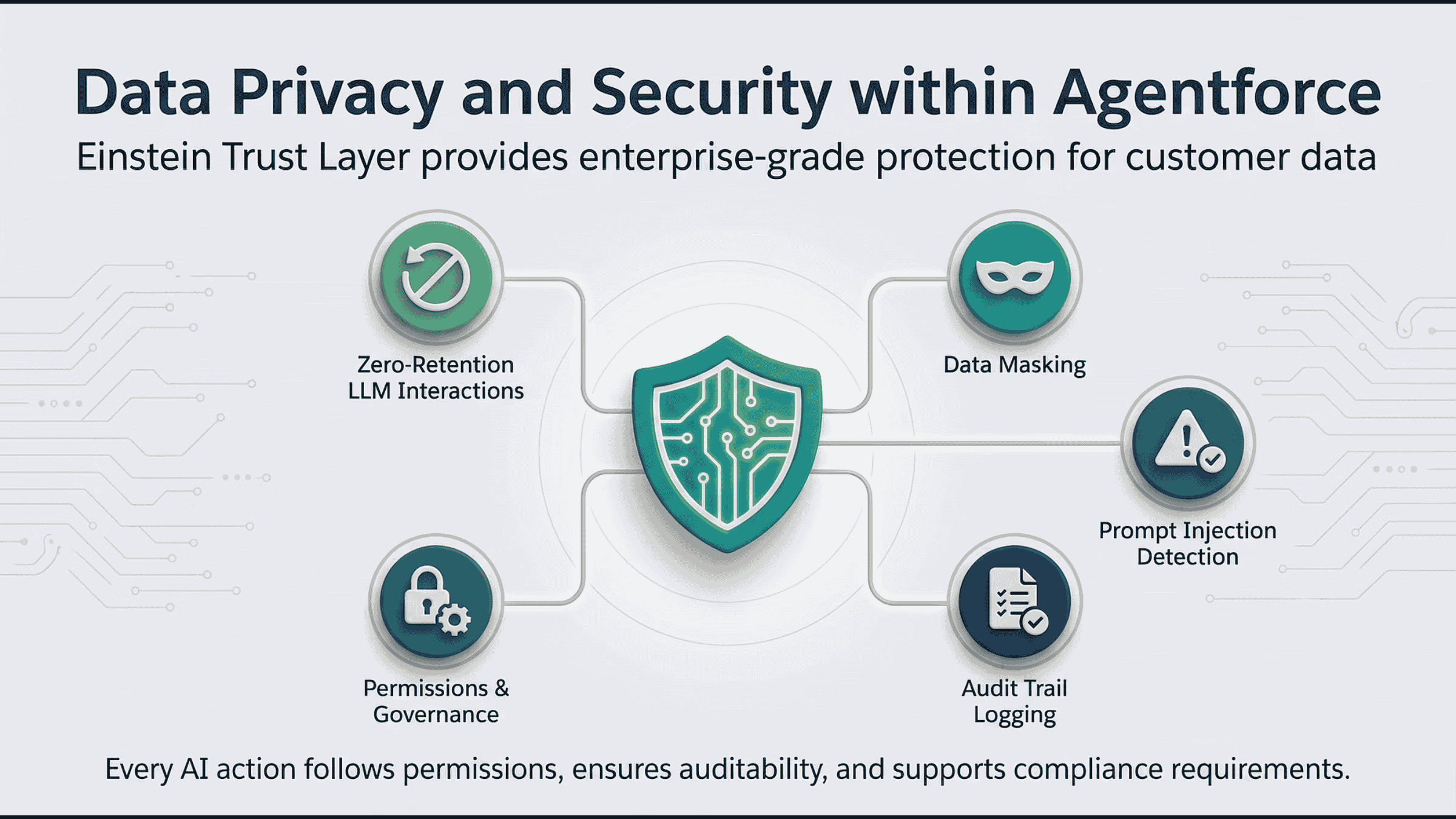
To put it simply, the Einstein Trust Layer ensures that every AI action follows permissions, auditability, and supports governance and compliance.
Comparing Einstein Copilot and Agentforce
Salesforce Agentforce vs Einstein Copilot, this comparison needs a more sophisticated analysis that goes beyond the surface-level features and focuses on how each tool helps oragnizations in improving customer interactions, business workflows, and drives outcomes.
Functional Differences
Here’s a detailed Salesforce AI tools comparison in terms of functional differences:
- Autonomy: While the Einstein Copilot uses LLM for natural language understanding, it functions only as an AI assistant that helps, guides, suggests, and answers the user prompts when asked. On the other hand, the Salesforce Agentforce combines LLMs with Agentic AI to perform as a team member with role-specific autonomous agents who act independently, automate workflows, perform multi-step actions, and handle customer interactions autonomously.
- Data Complexity: The Einstein Copilot can handle structured data and simple tasks such as sales queries, service assistance, etc. However, Agentforce employs the Atlas Reasoning Engine and Salesforce Data Cloud, which allows it to deeply understand and act on both structured and unstructured data and process complex workflows like compliance checks, cross-system orchestration, etc.
- Real-time Monitoring: It can detect prompt injections or flagged/toxic inputs in real-time.
- Customization: With Agent Builder in action, Agentforce offers users extensive customization options to design agents with pre-built actions or unique skills. Thus, providing flexibility to create customized autonomous workflows according to specific industries or use cases. On the contrary, Einstein Copilot’s customizations are limited to prompts and templates and are constrained to maintain predictability and human oversight.
- Integrations: The Einstein Copilot integrates deeply with different Salesforce platforms like Service Cloud, Sales Cloud, Slack, Marketing Cloud, Tableau, etc. Agentforce integrates seamlessly across the entire Salesforce ecosystem, including objects, automation tools, existing CRMs, ERPs like NetSuite, and different collaboration and data tools like Excel and Slack.
- Ease of Use: With Einstein Copilot, users need to set the path by providing prompts, rules to get the results; however, with Agentforce, teams can ‘set and forget’. The Agentforce will operate independently, thus freeing up teams to focus on other important tasks rather than execution.
Benefits and Limitations
While both the AI tools are efficient in their own way, they both have certain limitations too:
Benefits of Einstein Copilot
- Acting as a personal assistant, it provides user-guided assistance in suggesting next steps, creating drafts, summaries, or answering queries.
- Since it is natively embedded with Salesforce, it ensures to deliver relevant, trustworthy, and context-relevant information.
- Deals with structured data and provides an intuitive interface for users to provide prompts to receive responses.
- Cannot operate independently, requires human oversight and needs user input to start an action.
- Limited customizations and flexibility, which are mostly based on prompts.
- It cannot manage unstructured data or complex workflows that need deep analysis across multiple objects.
- Teams get the benefit of autonomous operations, in which the AI agents operate independently to complete tasks that too without any constant human oversight.
- Powered by using the Atlas Reasoning Engine, it can handle dynamic, complex workflows and multi-step tasks.
- It can process both structured and unstructured data and allows extensive customizations using Agent Builder and Agentforce Studio.
- Although powerful, in the case of complex industry use cases, it might require careful planning and robust governance.
- Advanced autonomous features of Agentforce might include an additional license cost.
- Has a steep learning curve for setup and configuration.
Instructions should be clear, specific, and actionable. Also, the topics should be clear and distinct to prevent overlapping, and the reasoning engine can correctly classify the user request.
Industry-Specific Applications
Several industries like SaaS, eCommerce, retail, financial services, and marketing benefit significantly by implementing Einstein Copilot and Salesforce Agentforce across different departments.
- Sales: While the Einstein Copilot helps in suggesting next best actions and forecasting sales trends, the Agentforce takes the lead in drafting personalized emails, automating lead management, and reducing responsive time.
Real-world example: A North American B2B company implemented Salesforce Einstein Copilot to combine multiple insights into a single conversational interface that allowed tailored data prompts, predictive scoring, and seamless integration. The result: 38% increase in deal cycle and 27% improvement in cross-sell revenue.
Similarly, a global software company implemented Agentforce to optimize lead management and enhance sales efficiency by configuring Agentforce Sales Agent, integrating Einstein Prediction builder, and connecting Sales Cloud and Data Cloud for a 360°view. Result: lead-to-opportunity conversion rates increased by 30% and response time reduced by 20%. - Customer Service: 72% of the industry leaders believe that AI can deliver better customer service than human agents. Einstein can optimize customer interactions, and Agentforce can empower AI-driven digital agents and automate customer support.
Real-world example: A retail company struggling with inefficient customer service and slow response time due to manual search, implemented Einstein Copilot and achieved a 45% increase in response time and a 30% improvement in customer satisfaction score.
In a similar use case, a telecommunications company implemented Agentforce for automating ticket triage and resolution. It integrated Data Cloud, trained Agentforce AI agents, and used Einstein GPT. Result: 40% decrease in average case resolution time, and enhanced CSAT by 25%. - Marketing Automation: Einstein Copilot can perform analysis on campaign data to improve marketing campaigns with data-driven insights. At the same time, Agentforce can use generative AI to personalize email campaigns and automate customer engagement.
Real-world example: A US Bank integrated Einstein engagement and sent time optimization to improve the declining email performance and personalize outreach. Result: A 31% increase in the open rate and an 18% increase in the click-through rate.
In another example, an eCommerce business which was struggling with poor campaign visibility, limited personalization, and inefficient utilization of marketing budgets implemented Agentforce for campaign management, customer segmentation, and analytics. Result: Improved campaign ROI by 40%, enhanced customer engagement, and actionable insights.
Business Benefits of Agentforce vs Einstein Copilot
Here is a table that explains a few of the defined actions in the Salesforce AgentForce ecosystem:
| Business Benefits | Agentforce | Einstein Copilot |
|---|---|---|
| Automation | Complete end-to-end automation of workflows without waiting for user triggers. | Assists users with suggested actions and content on demand. |
| Scalability | Multiple AI agents can scale effortlessly across teams and use cases. | Limited scalability depending on the number of prompts and user interactions. |
| Customer experience | Proactive, real-time customer engagement and fast problem-solving. | Enhanced response quality but triggered only through user input. |
| Cross-team collaboration | Workflow orchestration across services, sales, and marketing is automatic. | It can support individual teams but lacks coordination across functions. |
| Long-term cost efficiency | Reduced operational costs by minimum dependency on manual intervention. | Enhanced productivity, but it does not contribute significantly to reducing workload volume. |
| Complexity of use case | Best for complex, structured and unstructured data, multi-step processes and industry-specific applications. | Ideal for structured data, straightforward processes like summarization, drafting, and gaining insights. |
It is true that Einstein Copilot helps improve productivity, provides assistance, and ensures that Salesforce remains accessible through natural language, but it requires user input to start an action. On the other hand, Agentforce brings a more transformative shift by automating the execution of complex tasks and acting independently while keeping the opportunity to escalate when required.
Challenges and Considerations With Einstein Copilot and Agentforce
By now, it’s clear that both Einstein Copilot and Agentforce are useful and efficient AI capabilities; however, for businesses planning to implement for specific use cases or industry-specific requirements must know about potential challenges and considerations before integration:
- Data management and grounding: Autonomous AI systems are only as reliable as the data they are grounded in. So, if the underlying data is incomplete or inconsistent, the AI may generate incorrect outputs. Thus, ensuring strong data governance and quality checks for AI performance becomes critical.
- Permissions Management Strategies: Since Agentforce acts independently, establishing permissions management as a core control mechanism becomes important. Therefore, define clear, role-based permissions for agents so that they operate in defined boundaries, prevent unauthorized data access or premature approvals or workflows.
- Data privacy and responsibility: Even though the Einstein trust layer is present, ensuring data privacy and responsible AI is important. While implementing AI, organizations must ensure that sensitive data is properly classified and, the models adhere to regulatory requirements such as GDPR, HIPAA, and industry-specific compliance frameworks.
- Deciding which processes to automate: Organizations often consider Agentforce as a plug-and-play capability and automate every single process, even those which have a low impact. This results in misaligned AI agents, KPIs, and failed AI initiatives. Thus, before AI implementation, creating a business-led roadmap that clearly integrates cross-functional requirements across the teams is essential.
- Training: While most admins are comfortable with AI prompts and behavioural modelling, implementing, customizing AI agents, and mastering Agentforce might require a steep learning curve. Thus, providing structured and role-based training to different teams is necessary.
Which One to Choose: Agentforce Vs Einstein Copilot
Deciding between Agentforce and Einstein Copilot is more about how far you want to go with your AI implementation rather than selecting which is better.
For businesses that need efficient AI assistance in terms of insights, content drafting, and discovering the best next steps, without eliminating human control from the process, then Einstein Copilot is a strong fit. However, for organizations that need to operationalize at scale and need smart, role-based autonomous AI agents that can process complex workflows, unstructured data, in high-volume environments that too without manual oversight, then implementing Agentforce can be an ideal option.
While most businesses find value in using both, the ideal choice ultimately depends on the automation goals for your everyday workflows, operational maturity, and most importantly, whether you want AI assistance or an independent tool that handles everything quietly running in the background.
FAQs
- How to differentiate between Einstein Copilot and Agentforce?
The main difference is in terms of autonomy. Einstein Copilot is a conversational AI assistant that responds to user queries in natural language. At the same time, Agentforce executes tasks autonomously without waiting for human input. - What is the Atlas Reasoning Engine in Agentforce?
The Atlas Reasoning Engine is in the intelligence core behind Agentforce. It is responsible for breaking down the complex tasks, reason and evaluating outcomes and determining the best actions. - How can Agentforce be used for customer service automation?
Agentforce can deploy AI agents that can update records, resolve common issues, trigger follow-ups, triage cases, and escalate if required.