Salesforce CPQ: Effective Discounting Strategies
- February 6, 2026
- Posted by: SFDCGYM
- Category: Salesforce CPQ ,
Mastering Discounting Strategies in Salesforce CPQ
Discover how effective discounting strategies in Salesforce CPQ can transform your sales process and drive success. This guide will help you understand the nuances of discount schedules, explore their types, and offer step-by-step configuration guidance. Whether you’re a sales manager, CPQ administrator, or Salesforce developer, this comprehensive overview is designed for you.
Understanding Discount Schedules in Salesforce CPQ
Discount schedules in Salesforce CPQ are a powerful tool for implementing strategic pricing across various products and services. They allow businesses to adjust prices based on specific criteria, ensuring competitive offers while maintaining profitability. With Salesforce CPQ’s flexibility, you can easily manage discounting rules that adapt to customer needs and market conditions.
By utilizing discount schedules, businesses can streamline their pricing strategy, making it dynamic and responsive to demand. These schedules serve as a guiding framework, ensuring that discounts are applied consistently and transparently. This capability not only boosts sales efficiency but also enhances customer satisfaction by providing clear and attractive pricing

Exploring Types of Discounting in Salesforce CPQ
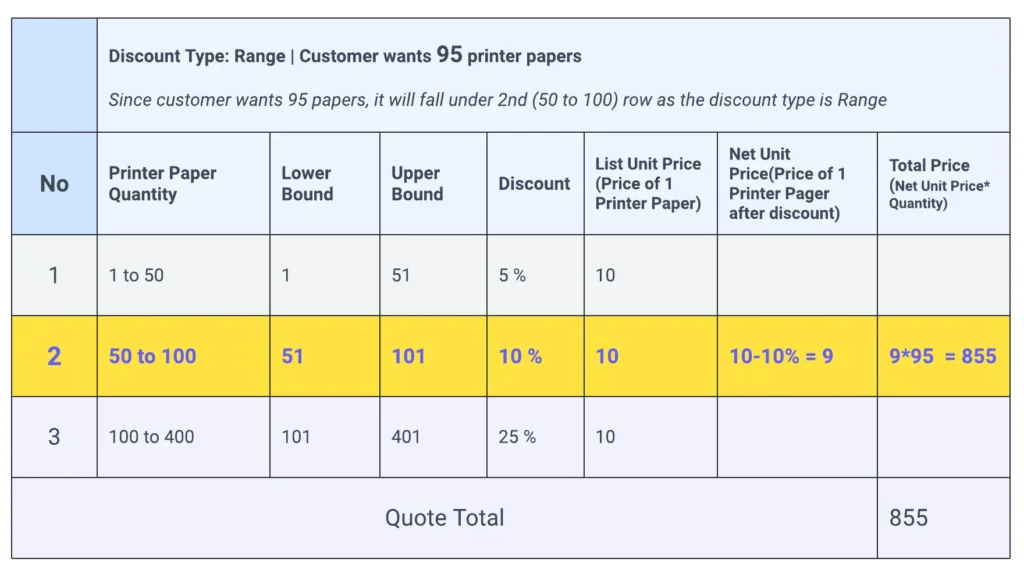
- Range Discounts: Range discounts apply a single discount percentage to a category or range of product quantities. This straightforward approach is easy to manage and communicate to customers.
In our printer paper example, a 5% discount might apply uniformly to all purchases within the 1-50 page range. This simplicity makes range discounts a popular choice for businesses seeking straightforward pricing strategies.
Let’s consider a scenario where a client orders 95 sheets of printer paper. This quantity falls within the 50 to 100 range, which corresponds to the second pricing tier. Consequently, the client receives a 10% discount applicable to all 95 sheets, demonstrating how range discounts effectively reward bulk purchases.
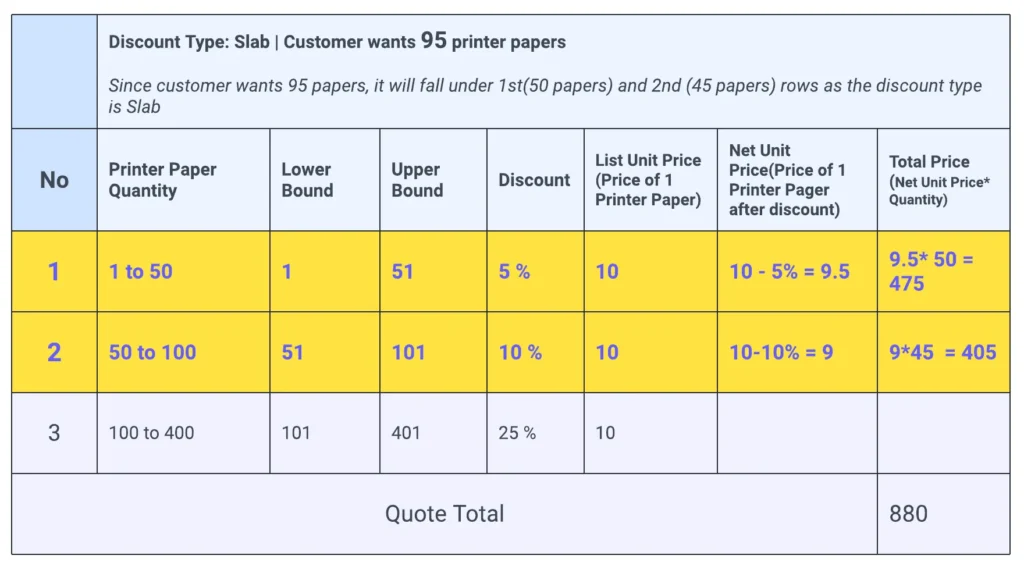
- Slab Discounts:Slab discounts apply different discount percentages to each segment of the purchase volume. This tiered approach allows businesses to offer escalating discounts as customers purchase larger quantities.
Continuing the printer paper scenario, a customer purchasing 95 pages would receive a 5% discount on the first 50 pages and a 10% discount on the remaining 45 pages. This layered strategy encourages incremental purchasing while maintaining control over discount levels.
Important Fields in Discount Schedules
Schedule Name
The schedule name is a crucial identifier for each discount schedule. It helps categorize and distinguish between multiple pricing strategies within Salesforce CPQ.
Type
The type field defines the discount strategy employed, such as volume-based, term-based, or cost-based. Accurately selecting this attribute ensures that the correct discount logic is applied.
Discount Unit
Discount units specify how discounts are calculated, whether as percentages, fixed amounts, or based on price adjustments. This flexibility allows businesses to tailor discounts to their unique sales models.
Aggregation Scope
Aggregation scope determines how discount calculations are aggregated across products, orders, or customer accounts. This setting influences the overall discount application and ensures accuracy in pricing calculations.
Cross Products
Cross-products settings enable discounts to apply across different product categories, enhancing the flexibility of pricing strategies and accommodating diverse customer needs.
Cross Orders
Cross-order discounts consider customer purchases over multiple orders, promoting long-term customer relationships and encouraging repeat business.
Include Bundled Quantities
This field ensures that bundled product quantities are included in discount calculations, maintaining consistency and accuracy in pricing.
Override Behavior
Override behavior settings dictate whether discounts apply to all qualifying tiers or only to the current tier. This choice affects how discounts are communicated and calculated.
Configuring Volume-Based Range Discounts in CPQ
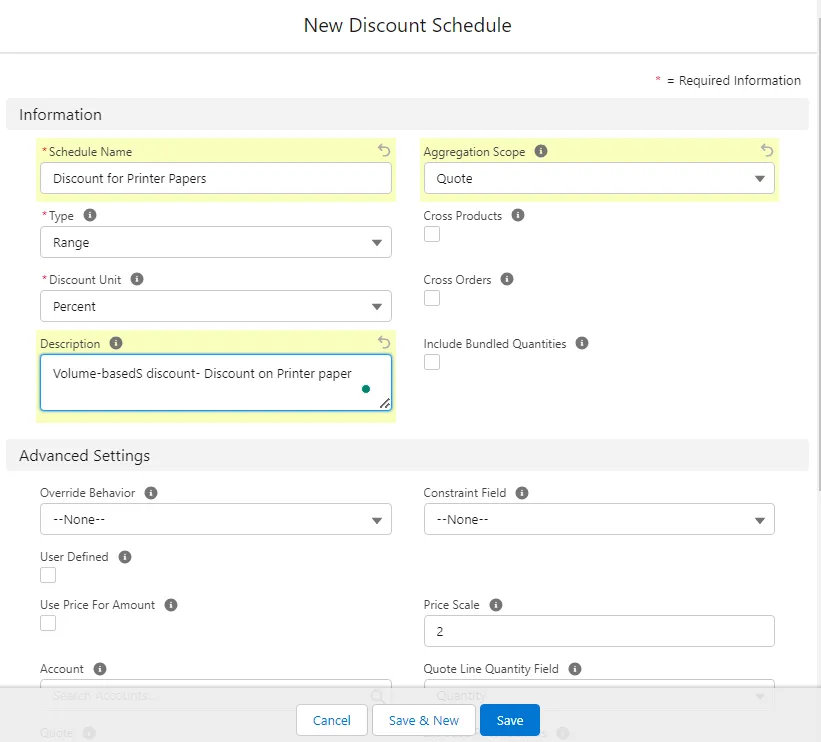
- Navigate to Discount Schedules: Begin by accessing the app launcher and searching for “Discount Schedules”. Once located, click on the “New” button to create a new discount schedule.
- Input Initial Values: In the setup form, enter the following details:
Schedule Name: Discount for Printer Papers
Type: Range
Discount Unit: Percentage
Description: Volume-based discount – Discount on Printer paper - Edit Discount Tiers: Click on the “Edit Tier” button to create the table that defines each discount tier as per your requirements.
- Link Discount to Product: Navigate to the “Product” tab and search for or create a product under the name “Printer Papers”. Within the Salesforce CPQ Discounting section, locate the Discount Schedule field and select “Discount for Printer Paper” from the dropdown.
- Finalize and Save Settings:Ensure all the details are correctly entered and save the changes to apply the discount schedule to the specified product. This setup will ensure that your pricing strategy is accurately implemented within the CPQ system.
After entering the values, make sure to save the record to store your configurations.
Configuring Volume-Based Slab Discounts in CPQ
-
- Establish Slab Tiers: Define discount slabs that accommodate escalating discount percentages as purchase volumes increase.
- Calculate Tier Discounts: Determine discount percentages for each slab tier, ensuring transparency and consistency.
- Configure Schedule Parameters: Set up schedule attributes to match the slab discount strategy, ensuring accurate and effective pricing.
Conclusion
In conclusion, mastering Contracted Pricing in Salesforce CPQ is a game-changer for businesses seeking efficient and consistent price management. By understanding the key fields, real-world applications, and step-by-step creation process, sales professionals, Salesforce admins, and developers can harness its potential to drive business success. Contracted Pricing not only streamlines pricing agreements but also strengthens customer relationships and enhances revenue stability.For further exploration and guidance, consider engaging with Salesforce CPQ experts or accessing additional resources to maximize your understanding and utilization of this powerful feature. By doing so, you’ll be well-equipped to unlock new opportunities and elevate your price management strategies to new heights.
Summary Of this Article
Why Discount Schedules Matter 📊 Discount schedules are essential tools that help you manage pricing strategies across different products and services. They ensure that your prices are competitive, consistent, and profitable. By setting up discount rules, your business can quickly adapt to market changes and customer demands, making your sales process smoother and more efficient.
Types of Discounts Explained 📈
1.Volume-Based Discounts: Encourage customers to buy in bulk by offering larger discounts as purchase quantities increase. For example, buy more printer paper and save more! 🖨️
2.Term-Based Discounts: Reward customers for longer commitments, like offering discounts on software subscriptions for longer terms. This builds customer loyalty.
3.Cost-Based Discounts: Set discounts based on the cost of goods to maintain profit margins while still being attractive to cost-conscious buyers.
Setting Up Discounts in CPQ ⚙️
To configure discounts like a pro, follow these steps:
1.Create Discount Schedules: Start by defining the type of discount (e.g., range or slab) and setting the percentage..
2.Link to Products: Attach these discounts to specific products, ensuring that they apply whenever a sale is made.
3.Finalize Settings: Double-check all entries to ensure accuracy and save changes to implement your strategy.
By leveraging these strategic discounting methods, you can enhance sales efficiency, boost customer satisfaction, and drive revenue growth. Dive into the world of Salesforce CPQ and unlock new opportunities for success! 🚀